
Moisture control after steam sterilisation
Technical guide on managing moisture levels in spices and agricultural products following industrial steam sterilisation treatments.
Introduction to steam sterilisation and moisture
Industrial steam sterilisation is a standard method used to reduce microbial load in spices and agricultural products, including pepper and other botanicals. During this treatment, high-temperature steam is injected into the product chamber to eliminate pathogens such as Salmonella and E. coli.
However, the introduction of live steam invariably transfers moisture to the product. If not managed correctly through immediate and precise post-treatment drying, excess residual moisture can trigger mold growth, insect infestation, and quality degradation during transit and storage. International buyers must evaluate how suppliers handle this critical processing phase.
The technical challenge of moisture re-absorption
When dry spices enter a steam steriliser, their initial moisture content typically ranges between 10% and 13%, depending on the specific commodity and origin. The steam treatment cycle raises the surface and internal moisture levels significantly, sometimes adding 2% to 5% of free water to the matrix.
If the product is packaged immediately while still warm and humid, condensation forms inside the liner. This creates localized micro-climates with high water activity (written aw, a measure of how much free water is available for microbes to use), which accelerates enzymatic activity and microbial proliferation. For detailed background on how raw materials are prepared before treatment, refer to our guide on how Vietnamese pepper is processed.
Post-sterilisation drying parameters
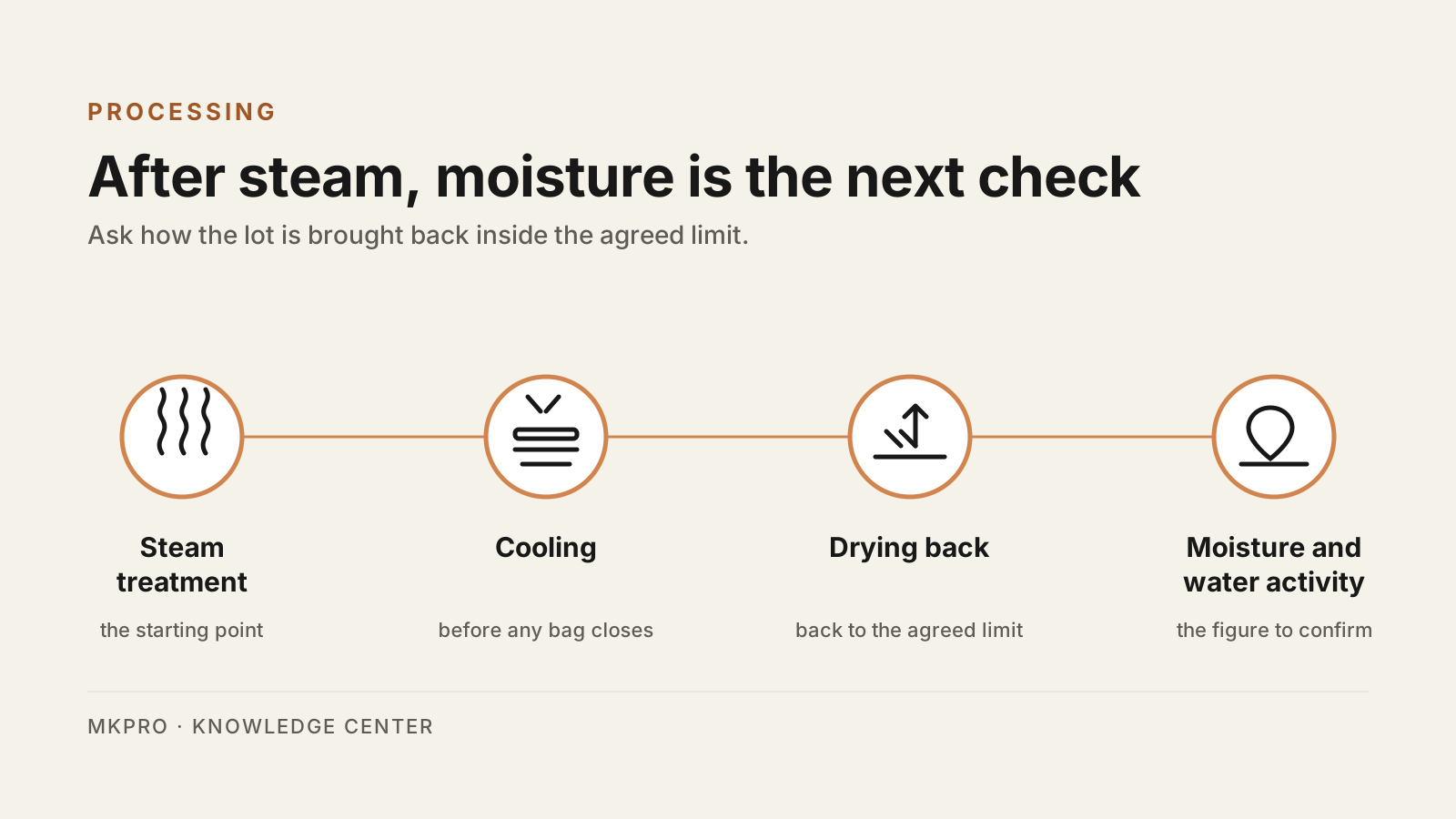
To prevent spoilage, the processed material must undergo a controlled cooling and drying phase immediately following sterilisation.
Key parameters to monitor
- Target moisture threshold: The product must return to its designated commercial moisture specification (for instance, black pepper specifications are detailed on the Vietnam black pepper page).
- Air temperature and velocity: Drying air must be filtered and maintained at optimal temperatures to drive off surface moisture without scorching or altering volatile oil profiles.
- Cooling time: Rapid cooling prevents thermal degradation and stops the product from retaining latent heat inside bulk containers.
The flow below shows what happens to the product after the steam cycle ends. Read it top to bottom: each arrow is one step, and the text beside the arrow says what changes.
[Steam steriliser]
        |
        v  moisture rises by 2% to 5%
[Drying and cooling unit]
        |
        v  moisture comes back down to the target level
[Resting and moisture testing]
        |
        v  only dry, tested product moves on
[Sealed, moisture-proof packaging]
Water activity (aw) vs. total moisture content
Experienced importers know that measuring only total moisture content is insufficient. Total moisture measures the percentage of water by weight, but water activity (aw) measures the energy status of the water in the product—specifically, the availability of free water to support microbial growth.
After steam sterilisation, a product may show an acceptable total moisture percentage on paper, but if the internal water activity remains above 0.65 aw, the risk of mold remains high. Importers should request specific water activity data alongside standard moisture test results when reviewing technical data sheets. Additional quality parameters for specific origins can be reviewed in the Vietnam spice export guide.
Packaging considerations for treated goods
Once the target moisture level is safely achieved and verified, packaging must protect the cargo from re-absorbing atmospheric humidity during sea freight. Standard packaging protocols often involve multi-wall paper bags combined with inner polyethylene (PE) liners or hermetic liners (such as GrainPro bags) that act as a moisture barrier.
Because shipping conditions vary widely across global routes, confirming the correct liner type and seal integrity is essential. You can review our standard offerings and submit specific technical inquiries through our contact page.
Questions for international buyers to ask suppliers
When sourcing steam-sterilised spices, international importers should clarify the following technical points with their processing partners:
- What is the exact drying method and dwell time utilized immediately after the steam cycle?
- Are both total moisture content and water activity (aw) measured on every batch?
- What specific barrier liners are used inside the export packaging to prevent moisture re-absorption during transit?
- Can processing parameters be adjusted to meet specific destination requirements not published in standard data sheets?
To discuss your technical specifications, trial orders, or specific post-processing requirements for our product range, please reach out directly via our contact page.
Frequently asked
How is Vietnamese black pepper graded?
Pepper is graded by density, expressed in grams per litre (G/L), together with a moisture ceiling and an admixture ceiling. The grades MKPRO quotes against are 500 G/L, 550 G/L, 570 G/L, 600 G/L and 620-625 G/L. Higher density grades are denser and heavier within the same volume.
What is the difference between FAQ 550 G/L and FAQ 570 G/L pepper?
Both are export grades of Vietnamese black pepper with the same moisture and admixture ceilings, but 570 G/L is denser. A buyer choosing between them is usually choosing between two positions in the same lot: 550 G/L is easier to fill and flows more freely, while 570 G/L gives a higher weight per volume for the same packing format.