
What FDA registration and an FSSAI licence mean for a buyer
Understand regulatory terms like FDA registration and FSSAI licences when importing spices and agricultural products from Vietnam.
When importing food ingredients, spices, and agricultural commodities from Vietnam, buyers frequently encounter regulatory terms such as US FDA registration and the Indian FSSAI licence. Navigating these requirements correctly is essential for customs clearance and legal market access. This article breaks down what these registrations and licences actually mean for an international importer, what they cover, and what verification steps a buyer should take before placing a commercial order.
To explore the core specifications of our primary bulk spice, review our detailed guide on Vietnam black pepper grades. For a broader overview of sourcing agricultural goods from the region, you can also consult our Vietnam spice export guide.
Understanding US FDA registration for foreign facilities
For any international supplier exporting food and agricultural products to the United States, compliance with the US Food and Drug Administration (FDA) is mandatory under the Public Health Security and Bioterrorism Preparedness and Response Act of 2002.
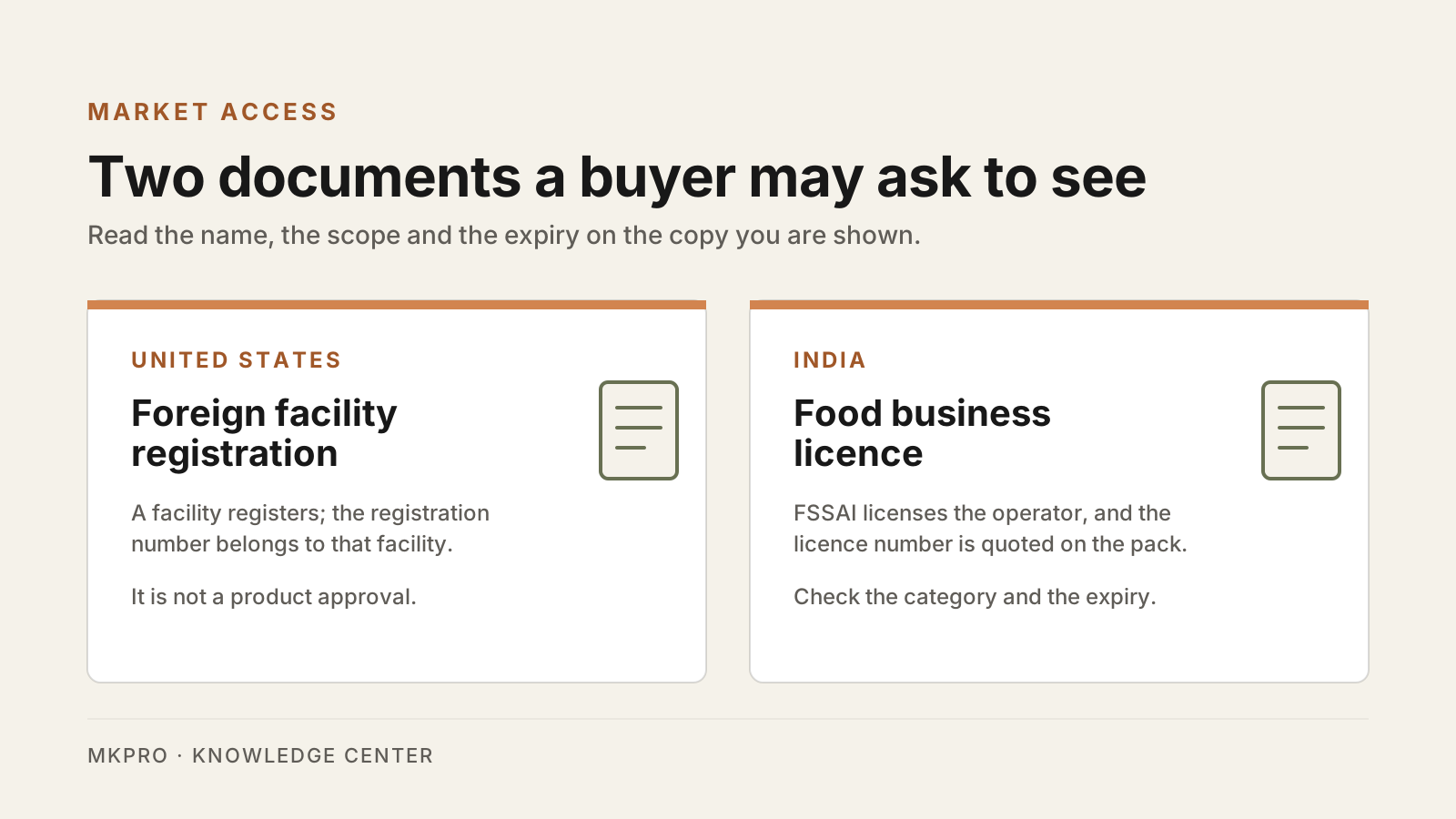
An FDA registration applies to the specific food facility where the product is manufactured, processed, packed, or held for distribution. It is important to note what FDA registration is—and is not:
- It is not an endorsement or validation: An FDA registration number simply means that the facility has provided its contact details and product categories to the agency. The FDA does not pre-approve, endorse, or “certify” foreign processing plants through this registration alone.
- Prior Notice is still required: In addition to facility registration, every individual shipment destined for US ports requires a Prior Notice submission to the FDA prior to arrival.
- Inspections happen independently: The FDA inspects foreign facilities based on risk assessment, and facility registration does not substitute for actual compliance with Current Good Manufacturing Practice (CGMP) regulations.
When sourcing items such as Vietnam pepper, cinnamon, star-anise, cashew, coconut, or coffee destined for the US market, buyers should always request the exact FDA registration number and verify active status through the official FDA Industry Systems portal.
The role of an FSSAI licence for the Indian market
If you are importing agricultural products or spices into India, compliance with the Food Safety and Standards Authority of India (FSSAI) is governed by the Food Safety and Standards Act, 2006.
Foreign food business operators who intend to export goods to India must meet specific importer-of-record and compliance standards. Key points for buyers include:
- Importer responsibility: The Indian importer holds the primary legal responsibility for ensuring that imported consignments comply with FSSAI standards regarding maximum residue limits (MRLs), contaminants, and labeling.
- Product standards: FSSAI sets strict compositional parameters for spices, nuts, and dry fruits. Importers must ensure that the specific grades—such as specific density metrics for pepper or kernel sizes for cashews—match local regulatory definitions at the port of entry.
- Port health checks: Consignments arriving at Indian ports are sampled and tested by FSSAI-notified laboratories. Having clear, pre-shipment certificates of analysis matching these parameters prevents costly port demurrage.
What buyers should verify during supplier evaluation
Because regulatory terminology can sometimes cause confusion during vendor selection, procurement teams should maintain a structured checklist. Never rely solely on marketing claims about regulatory status. Instead, ask concrete questions:
- What is the exact FDA registration number of the packing or processing facility, and is it currently active for the specific food product category being purchased?
- How does the supplier coordinate with local import agents to ensure that documentation aligns with FSSAI requirements when shipping to Indian destinations?
- Which third-party laboratory performs batch-level testing for moisture, density, and microbiological parameters prior to loading?
- Are analytical reports provided for every lot, and can they be cross-referenced against container seal numbers?
For specific inquiries regarding documentation, product availability, or to discuss your compliance requirements for a planned shipment, please reach out to our team directly through the contact page. We are ready to provide technical specifications and answer detailed compliance questions on request.
Frequently asked
How is Vietnamese black pepper graded?
Pepper is graded by density, expressed in grams per litre (G/L), together with a moisture ceiling and an admixture ceiling. The grades MKPRO quotes against are 500 G/L, 550 G/L, 570 G/L, 600 G/L and 620-625 G/L. Higher density grades are denser and heavier within the same volume.
What is the difference between FAQ 550 G/L and FAQ 570 G/L pepper?
Both are export grades of Vietnamese black pepper with the same moisture and admixture ceilings, but 570 G/L is denser. A buyer choosing between them is usually choosing between two positions in the same lot: 550 G/L is easier to fill and flows more freely, while 570 G/L gives a higher weight per volume for the same packing format.