
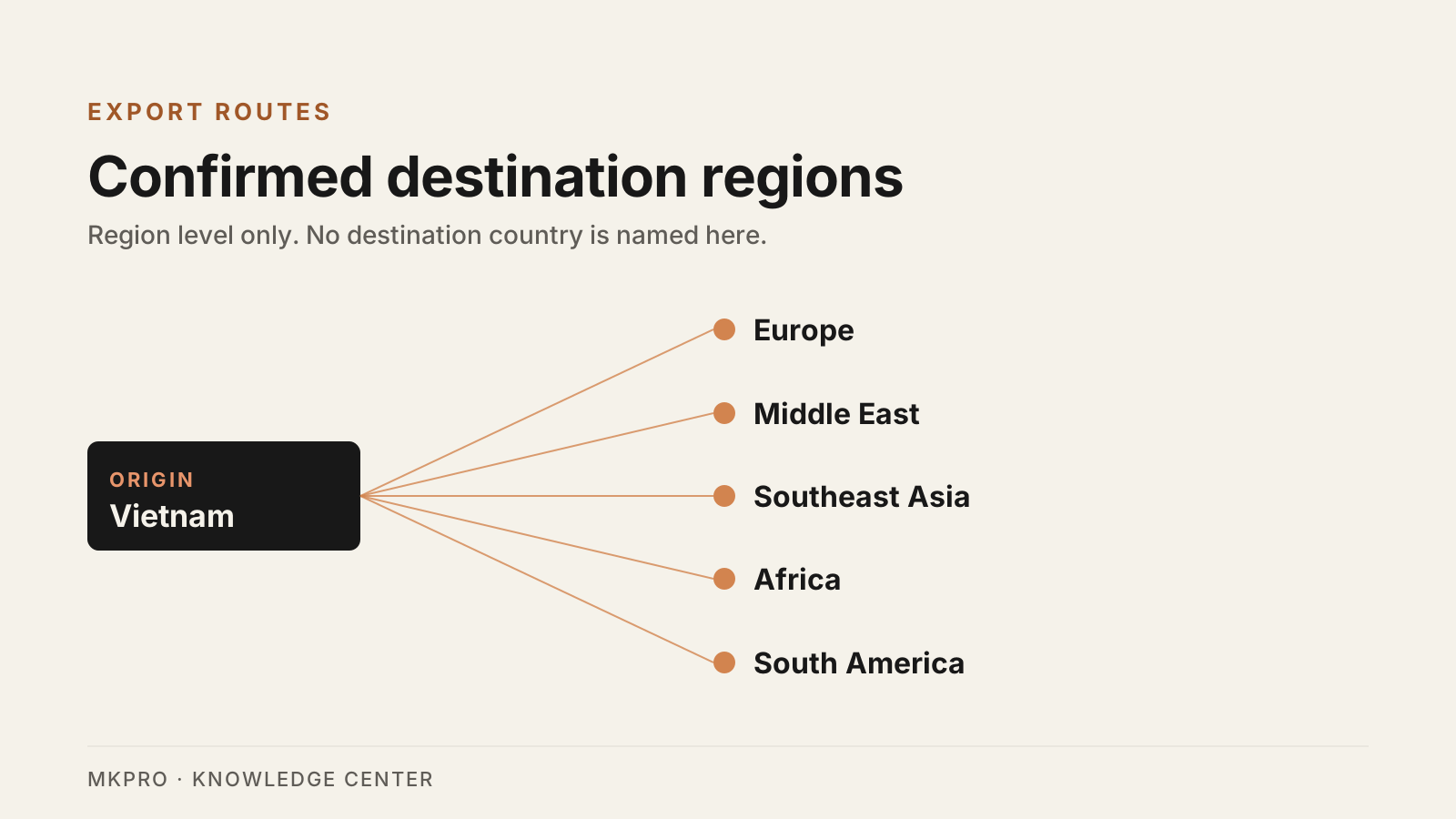
Which destination regions Vietnamese spice exports serve
An overview of destination regions for Vietnamese agricultural products and spices based on trade flows and general shipping routes.
International spice and agricultural trade depends on structured logistics, port accessibility, and regional demand. When international buyers evaluate sourcing options from origin countries, understanding macro-level trade routes helps clarify transit times and port connectivity. This article examines the primary destination regions that receive Vietnamese agricultural products, including black pepper, cinnamon, star anise, cashew nuts, desiccated coconut, and coffee beans.
Major Global Trade Corridors for Vietnamese Spices
Vietnam operates as a significant origin hub for bulk agricultural commodities and spices. General global trade flows route these commodities through major ocean shipping lanes originating from southern ports. While specific buyer destinations vary by contract, macroeconomic trade data outlines several primary geographic destination regions for Vietnamese agricultural products.
Buyers operating in these regions typically coordinate shipments based on standard maritime routes connecting Southeast Asian ports to major global transshipment hubs. For a detailed breakdown of how commercial risk shifts along these routes, review our guide on how Incoterms shift risk in a spice container shipment.
1. Asia-Pacific and South Asia
Proximity makes regional Asian markets a primary destination for raw and semi-processed agricultural goods.
- Neighboring manufacturing and blending hubs import substantial volumes of bulk spices and coffee for local consumption or further industrial processing.
- Transit times within regional Asian trade lanes are relatively short compared to transatlantic or transpacific voyages, often requiring fewer weeks from port to port.
- Importers in these regions frequently source products such as Vietnam Pepper and Vietnam Cinnamon for direct blending or wholesale distribution.
2. Middle East and North Africa (MENA)
The MENA region represents another prominent destination corridor for distinct agricultural grades.
- Culinary traditions across the Middle East utilize high volumes of aromatic spices, including Vietnam Star Anise and high-density pepper grades.
- Major ports in the Gulf Cooperation Council (GCC) serve as entry points for dry containerized cargo, which is then redistributed inland.
- Trade finance and container logistics along this corridor typically run through established hub ports in Southeast Asia and the Middle East.
3. European Union and Western Europe
European food and beverage manufacturers maintain steady demand for industrial-grade agricultural inputs.
- Buyers in European markets often require rigorous physical and chemical specifications, particularly regarding moisture levels, foreign matter limits, and specific processing options.
- Importers in this region frequently source Vietnam Cashew Nuts and Vietnam Coffee Beans for roasting, snacking, and retail packaging.
- Shipments to European ports require careful humidity management to prevent condensation during extended voyages through varying climate zones.
4. North America
North American markets—primarily the United States and Canada—import substantial quantities of bulk spices and nuts for retail and food service supply chains.
- Containerized shipments cross the Pacific Ocean to West Coast ports or route through the Panama Canal to East Coast destinations.
- Importers targeting these markets generally evaluate specifications aligned with international quality standards. To understand how regulatory filings apply to these shipments, consult our article on what FDA registration and an FSSAI licence mean for a buyer.
Evaluating Destination-Specific Requirements
When sourcing from origin, international buyers must align their destination country regulations with available product specifications. Because named destination export markets (country level) depend on specific contract terms, buyers should verify logistics capabilities directly.
| Destination Region | Common Logistical Route | Typical Product Categories | Primary Consideration |
|---|---|---|---|
| Asia-Pacific | Direct intra-Asia shipping lanes | Pepper, coffee, cinnamon | Transit time, regional frequency |
| MENA | Maritime routes via Indian Ocean | Star anise, pepper, coconut | Container availability, port congestion |
| European Union | Trans-oceanic via Suez or Cape | Cashew, coffee, spices | Moisture control, regulatory compliance |
| North America | Trans-Pacific or Panama Canal | Cashew, coconut, pepper | Extended transit times, port handling |
For a comprehensive overview of how agricultural commodities transition from raw farm outputs to container-ready goods, read the Vietnam spice export guide.
Confirming Routing and Specifications for Your Destination
Every trade lane presents unique logistical variables, from container line schedules to destination port regulations. Whether your warehouse is located in a regional Asian hub or a North American distribution center, verifying transit parameters ensures smooth supply chain execution.
To discuss specific destination routing, port availability, or product grades for your market, please contact our team.
Frequently asked
How is Vietnamese black pepper graded?
Pepper is graded by density, expressed in grams per litre (G/L), together with a moisture ceiling and an admixture ceiling. The grades MKPRO quotes against are 500 G/L, 550 G/L, 570 G/L, 600 G/L and 620-625 G/L. Higher density grades are denser and heavier within the same volume.
What is the difference between FAQ 550 G/L and FAQ 570 G/L pepper?
Both are export grades of Vietnamese black pepper with the same moisture and admixture ceilings, but 570 G/L is denser. A buyer choosing between them is usually choosing between two positions in the same lot: 550 G/L is easier to fill and flows more freely, while 570 G/L gives a higher weight per volume for the same packing format.