
Black Pepper: Export Quality Standards and Essential Uses
How export-quality black pepper is judged — the grading basis, the harvest-to-bag processing flow, and which application each form is selected for.
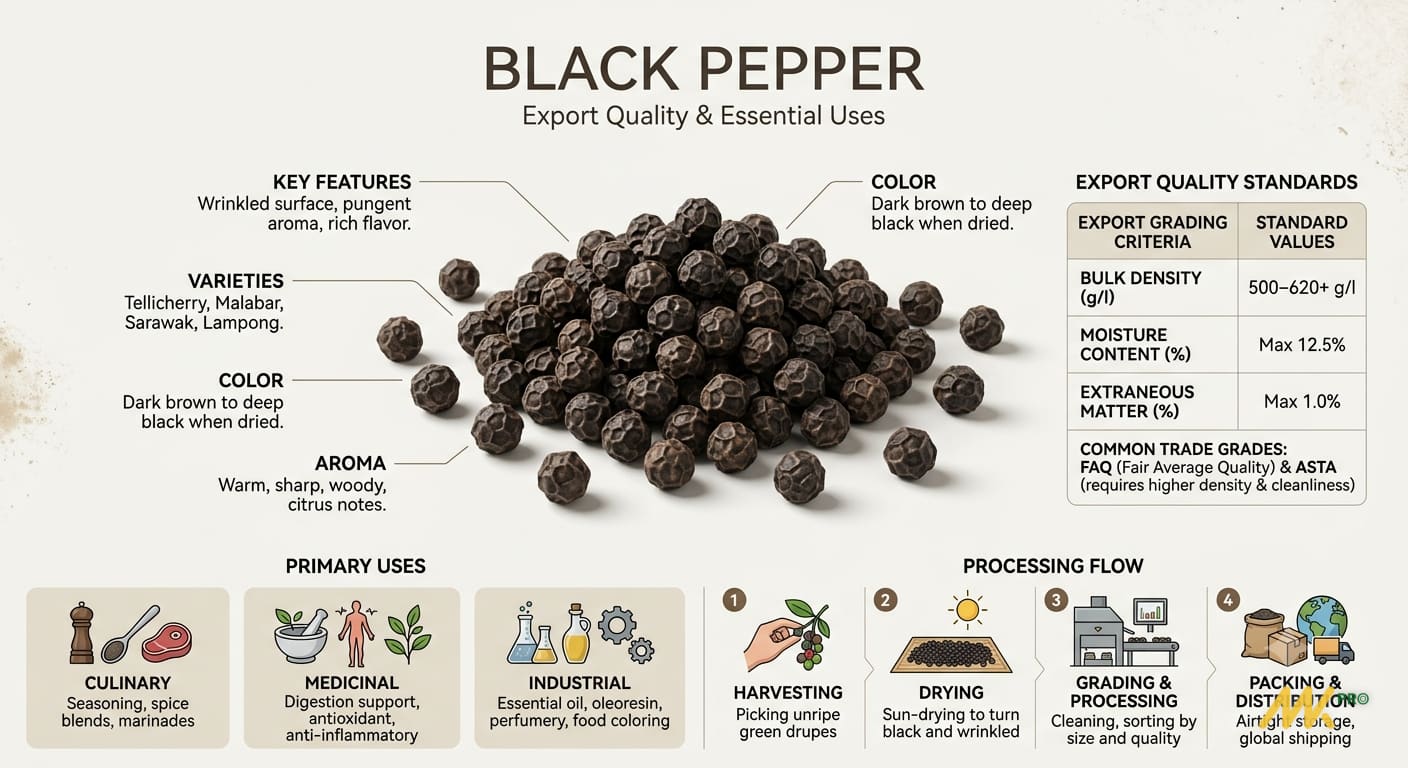
The image above answers three questions at a glance: how a lot of black pepper is graded, what the peppercorn is used for, and how it travels from harvest to bag. This article unpacks each panel and points at where the confirmed figures live.
How export quality is judged
Black pepper is not graded on taste. It is graded on a small set of measurable parameters, and the black pepper specification table publishes the limits for each grade:
- Bulk density, expressed in grams per litre, is the primary grading axis.
- Moisture carries a maximum limit per grade.
- Admixture caps the foreign and defective material a buyer will accept.
Density is the parameter most buyers lead with, because it drives both appearance and usable yield: a denser peppercorn is generally fuller and yields more per kilogram. The published table runs from an entry-level position to the top of the range, so a grade can be selected for the application rather than defaulted to.
The limits differ by grade, and this article deliberately does not repeat them. There is one source for those figures: the specification table on the product page.
Varieties, and what they are not
The infographic names Tellicherry, Malabar, Sarawak and Lampong. These are origin names from other pepper-producing countries — India, Malaysia and Indonesia — and they are useful context for a buyer comparing quotations across origins. They are not a statement about what this listing supplies. Pepper offered here is of Vietnamese origin.
Trade grades, and the one not on the table
The published grading labels carry the FAQ prefix — Fair Average Quality, the common baseline for traded lots. The infographic also references ASTA as a standard asking for higher density and cleanliness. ASTA tolerances are not part of the table on the product page, so a buyer who needs an ASTA-graded lot should state that tolerance in the enquiry rather than assume it is the default.
What the peppercorn is used for
The second panel sorts applications into three groups. For a buyer, the group matters because it changes which parameters become binding:
- Culinary. Seasoning, spice blends, marinades and table grinding. Appearance, density and freedom from admixture are the visible criteria, because the buyer sees the whole peppercorn.
- Industrial. Essential oil, oleoresin, perfumery and food colouring. These buyers work to an extraction yield, so density and moisture matter more than cosmetic appearance.
- Traditional and wellness formulations. Included here because whole peppercorn demand covers it. This listing makes no health claim about pepper: any health-related positioning in a finished product is the buyer’s own regulatory responsibility, assessed on the buyer’s own evidence.
From harvest to bag
The processing panel is four steps, and each one can move a specification:
- Harvesting. Unripe green drupes are picked before they redden, which is what keeps the finished peppercorn dark rather than pale.
- Drying. Sun-drying turns the drupe black and wrinkled. This is where the moisture limit is largely won or lost, so it is the step to ask about when the specification is tight.
- Grading and cleaning. Machine cleaning and sorting by size and by quality, which is where admixture is controlled.
- Packing. Airtight packing for storage and shipment. Formats are listed under packaging, and the loading port sits on the logistics data rather than in this prose.
What to put in an enquiry
State the product form — whole black peppercorn, machine cleaned — the density grade, the tolerances you need on moisture and admixture, your packing format and your destination. Incoterms and the documents supplied with a shipment are covered in the FAQ, and the specification table is on the black pepper product page. Anything not on the table — including an ASTA tolerance or a packing format that is not listed — is answered per enquiry.
Frequently asked
How is Vietnamese black pepper graded?
Pepper is graded by density, expressed in grams per litre (G/L), together with a moisture ceiling and an admixture ceiling. The grades MKPRO quotes against are 500 G/L, 550 G/L, 570 G/L, 600 G/L and 620-625 G/L. Higher density grades are denser and heavier within the same volume.
What is the difference between FAQ 550 G/L and FAQ 570 G/L pepper?
Both are export grades of Vietnamese black pepper with the same moisture and admixture ceilings, but 570 G/L is denser. A buyer choosing between them is usually choosing between two positions in the same lot: 550 G/L is easier to fill and flows more freely, while 570 G/L gives a higher weight per volume for the same packing format.