
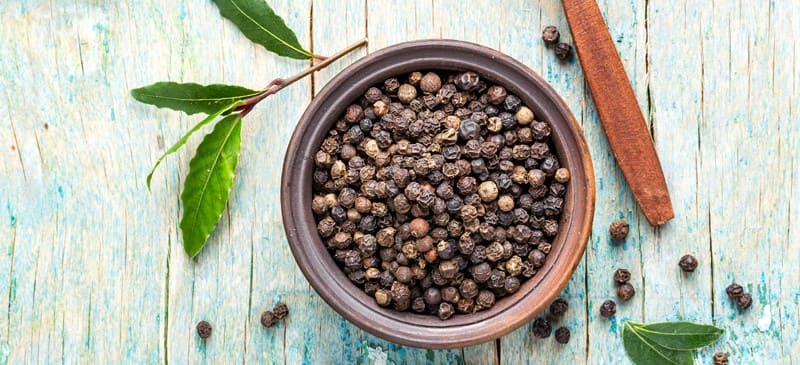
How Black Pepper Grows
What the Piper nigrum vine needs to thrive, from tropical climate to harvest — and why origin and handling matter for export quality.
Black pepper comes from Piper nigrum, a woody perennial vine native to southern India and now cultivated across tropical regions worldwide, including Vietnam. Understanding how the vine grows helps buyers understand why origin, harvest timing and post-harvest handling directly affect the density and appearance of the peppercorn they receive.
Climate requirements
Piper nigrum thrives in warm, humid tropical climates. It grows best where temperatures stay consistently above 18°C and rarely drop below that threshold — cooler conditions slow or stop growth entirely. The vine favours partial shade and high humidity, which is why it is often grown as an understory crop beneath taller trees. These conditions are met across Vietnam’s Central Highlands and Southeast regions, where pepper is a long-standing cultivated crop.
Growth habit
The vine is a climbing plant that can reach several metres in height when supported. It roots wherever the stem touches the ground, and without regular pruning it spreads outward and becomes difficult to manage. Commercially, the vine is trained on a support structure — a trellis, post or living tree — to keep the fruiting spikes within easy reach and to improve airflow around the foliage.
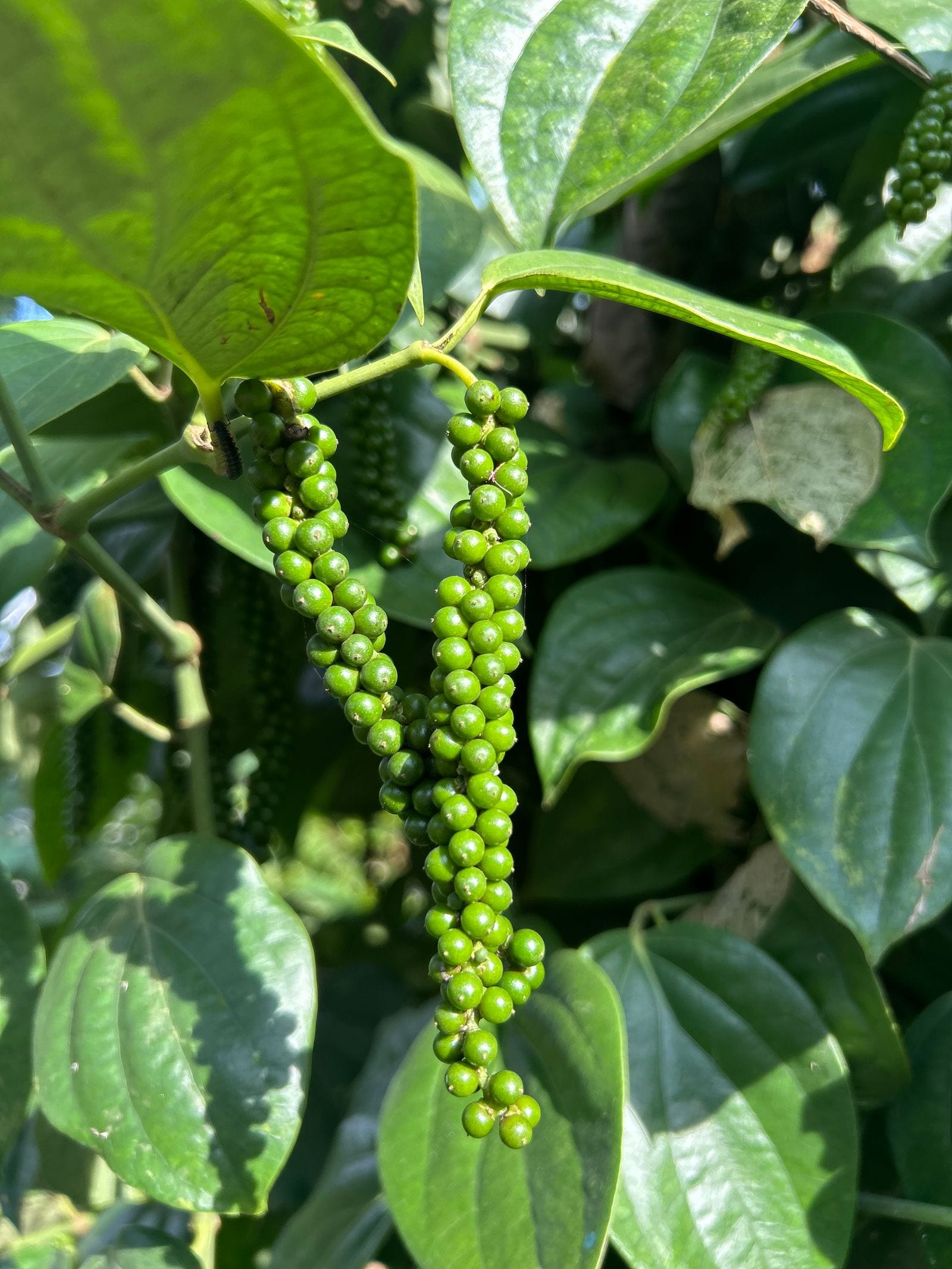
The leaves are broad, alternate and distinctly ribbed, with a deep green colour. A healthy, well-maintained vine produces between 20 and 30 fruiting spikes per season, each bearing the small flowers that develop into peppercorn clusters.
Flowering and fruiting
The vine produces small, white, self-fertile flowers arranged on slender hanging spikes. These flowers develop into drupes — small, round, green berries clustered along the spike. Each berry contains a single seed. It is this berry, harvested and dried, that becomes the peppercorn traded on the export market.
Three types of pepper from one vine
Black, white and green pepper all come from the same Piper nigrum vine. The difference between them is not the plant — it is the harvest timing and the processing method applied to the berry.
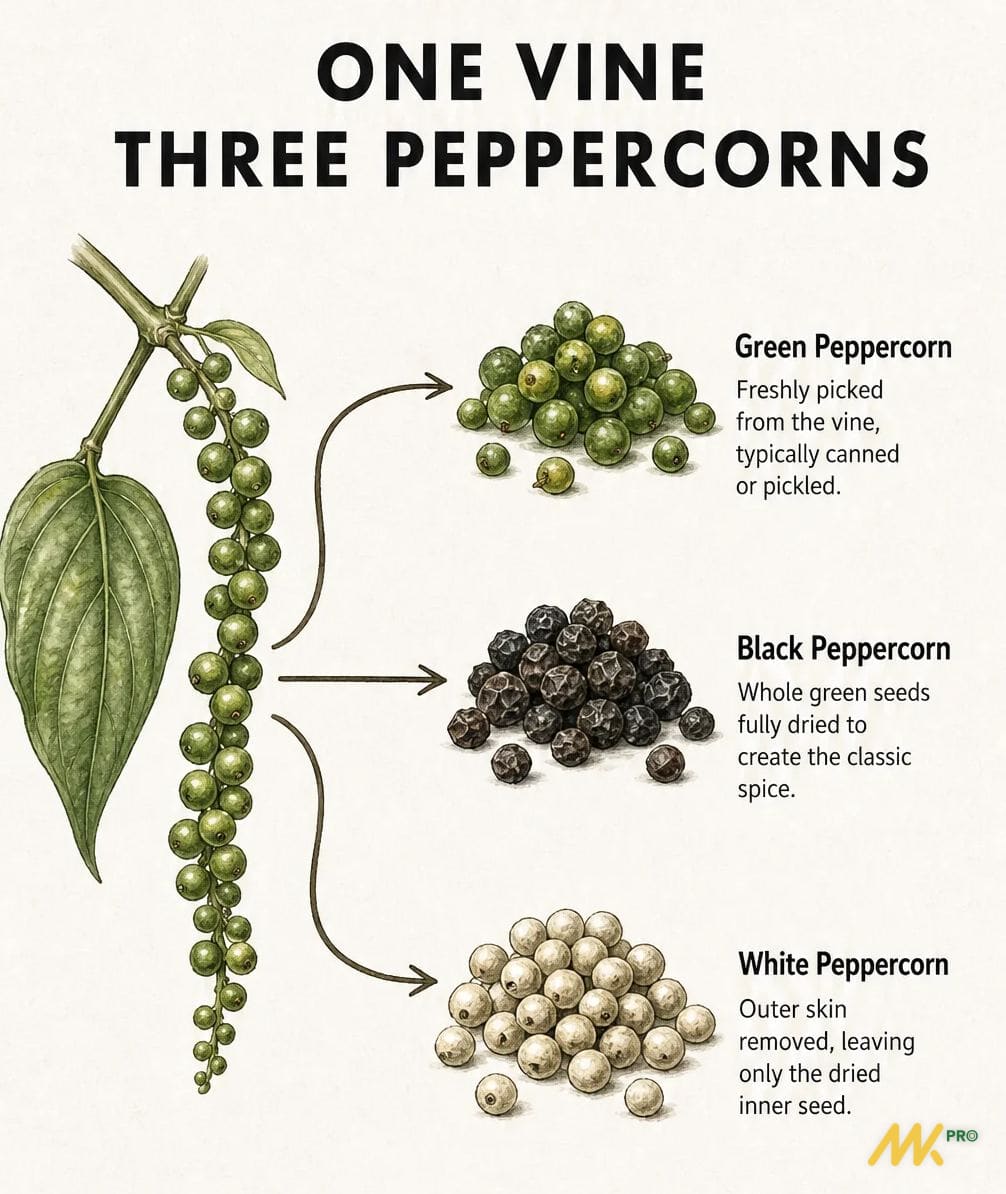
Green pepper is the fresh berry, harvested before it is fully ripe. It is typically canned, pickled or freeze-dried to preserve its bright colour and mild, fresh flavour. Green pepper is a perishable product and is traded in a different supply chain from dried pepper.
Black pepper is the most common form. The berries are harvested when fully ripe and then dried — traditionally in the sun — until the outer flesh shrinks and darkens around the seed. This is the form that is graded by density, cleaned and packed for export.
White pepper is produced by removing the outer flesh of the ripe berry and drying only the inner seed. The result is a lighter-coloured peppercorn with a different flavour profile and different density characteristics from black pepper. White pepper is specified separately rather than offered as a grade of black.
These post-harvest steps are where quality is decided — and they are the steps MKPRO controls at processing. The care taken at drying, cleaning and grading is what determines whether a lot meets a buyer’s density, moisture and admixture specification.
Why growing conditions matter for buyers
A vine grown in the right climate, harvested at the right moment and dried under controlled conditions produces peppercorn that is dense, clean and uniform. Poor growing conditions, uneven drying or delayed processing produce lighter peppercorn, higher admixture and lower density — all of which move a lot out of spec.
This is why the origin of a pepper lot is not a marketing detail. It is a physical property of the product, and it is why Vietnam black pepper is specified by grade rather than by origin alone.
To understand how Vietnamese pepper moves from harvest to packed export lot, see how Vietnamese pepper is processed.
Frequently asked
How is Vietnamese black pepper graded?
Pepper is graded by density, expressed in grams per litre (G/L), together with a moisture ceiling and an admixture ceiling. The grades MKPRO quotes against are 500 G/L, 550 G/L, 570 G/L, 600 G/L and 620-625 G/L. Higher density grades are denser and heavier within the same volume.
What is the difference between FAQ 550 G/L and FAQ 570 G/L pepper?
Both are export grades of Vietnamese black pepper with the same moisture and admixture ceilings, but 570 G/L is denser. A buyer choosing between them is usually choosing between two positions in the same lot: 550 G/L is easier to fill and flows more freely, while 570 G/L gives a higher weight per volume for the same packing format.