
What food safety systems cover in a spice supply chain
Understand what standard quality frameworks address in pepper, cinnamon, and star anise processing, and what documentation buyers should request.
International spice buyers evaluating Vietnamese agricultural exports frequently encounter references to standardized quality management frameworks. Whether reviewing documentation for bulk consignments of Vietnam Pepper, Vietnam Cinnamon, or Vietnam Star Anise, understanding the operational scope of these systems helps procurement teams define clear technical requirements before issuing purchase orders.
This article examines what structured quality programs control during raw material handling, processing, and container stuffing, and outlines what buyers should verify during supplier evaluation.
Hazard analysis and critical control points in processing
A hazard analysis framework focuses on identifying and controlling biological, chemical, and physical hazards throughout the manufacturing sequence. In spice processing plants, raw agricultural commodities arrive directly from growing regions carrying field contaminants, including mineral dust, foreign debris, and microbiological loads.
Process controls typically focus on several distinct operational steps:
- Raw material reception: Incoming lots undergo visual inspection, lot identification, and initial moisture assessment. Lots exceeding moisture thresholds risk microbial proliferation and are routed for additional drying.
- Cleaning and sorting: Mechanical separation equipment, gravity tables, and optical sorters remove foreign matter, stones, stems, and light seeds. For specific product lines, physical separation parameters are adjusted based on particle size and density.
- Reduction and grading: Milling or sizing operations follow strict sanitary design standards to prevent metallic contamination or cross-contact between botanical varieties.
- Pathogen reduction: Where specified by buyer requirements, treatments such as steam sterilization or alternative decontamination protocols reduce microbial counts without compromising volatile oil content.
For detailed information on how raw material is prepared for global dispatch, review our guide on how Vietnamese pepper is processed.
Management system standards for operational governance
While hazard analysis targets specific operational steps, broader system standards govern organizational management, documentation control, and traceability across the entire enterprise.
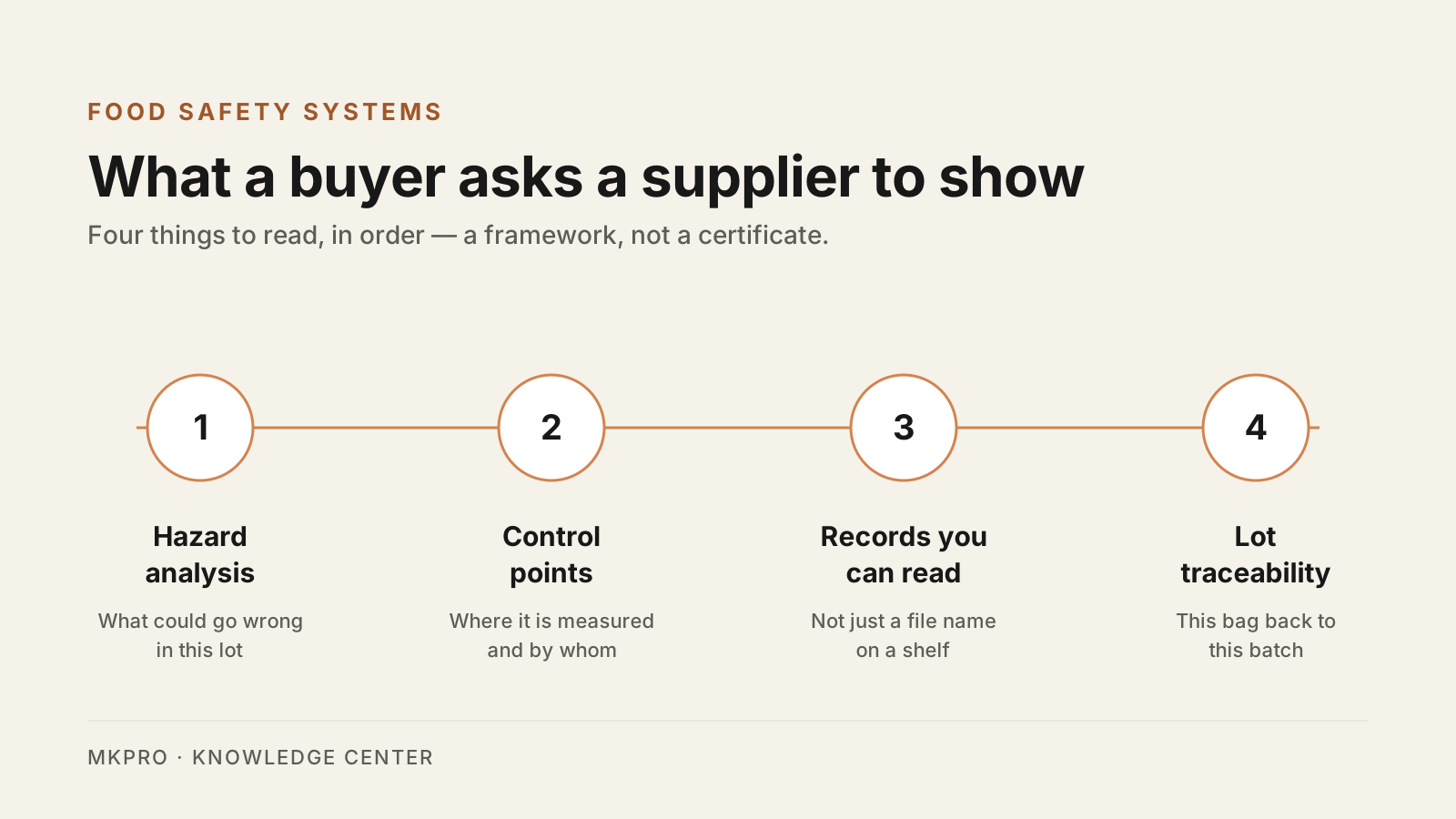
Buyers reviewing supplier credentials should distinguish between site-specific operational controls and broader management frameworks. Because specific institutional approvals depend on individual supplier audits, buyers must request verification of exact site credentials directly. Any claim regarding site compliance status should be cross-referenced against official audit reports or confirmed in the quotation.
When evaluating system documentation, procurement professionals should examine how suppliers manage the following operational elements:
- Traceability protocols: The ability to trace finished lots back through intermediate processing stages to specific raw material intake records and growing regions.
- Supplier verification: Incoming qualification procedures for raw agricultural inputs sourced from collection agents or local aggregators.
- Environmental hygiene: Infrastructure maintenance, pest control programs, and sanitary standard operating procedures (SSOPs) within processing areas.
- Calibration management: Routine verification of weighing scales, moisture meters, and metal detection equipment to ensure measurement accuracy.
What buyers should verify during supplier assessment
When establishing new vendor relationships for spices and agricultural commodities, relying solely on general declarations of compliance is insufficient. Procurement teams should request specific, verifiable documentation aligned with their destination market requirements.
Questions buyers should raise with potential suppliers include:
- What specific quality management system documentation is available for review prior to contract finalization?
- Are analytical test reports provided for every individual shipping lot, and do they cover moisture, density, and physical purity?
- Which independent laboratories perform analytical testing for pesticide residues and microbiological parameters?
- How are packaging materials inspected and stored to prevent re-contamination of finished goods prior to stuffing?
For additional context on regulatory compliance and import requirements, consult our overview on what FDA registration and an FSSAI licence mean for a buyer.
Conclusion
Structured food safety and quality management frameworks provide a foundation for consistent spice supply chains. By focusing on verifiable operational controls, thorough documentation, and clear technical specifications, international buyers can mitigate supply risks effectively.
To discuss specific technical parameters, review product specifications, or request documentation for upcoming shipments, please contact our team.
Frequently asked
How is Vietnamese black pepper graded?
Pepper is graded by density, expressed in grams per litre (G/L), together with a moisture ceiling and an admixture ceiling. The grades MKPRO quotes against are 500 G/L, 550 G/L, 570 G/L, 600 G/L and 620-625 G/L. Higher density grades are denser and heavier within the same volume.
What is the difference between FAQ 550 G/L and FAQ 570 G/L pepper?
Both are export grades of Vietnamese black pepper with the same moisture and admixture ceilings, but 570 G/L is denser. A buyer choosing between them is usually choosing between two positions in the same lot: 550 G/L is easier to fill and flows more freely, while 570 G/L gives a higher weight per volume for the same packing format.